Check requirements for Asia's Retirement Visas
True Story: A Survivor’s Story About the Stroke That Shouldn’t Have Happened
Have you ever been told, "You're doing great for your age"? I certainly had. I don't smoke, I don't drink, and I ran three kilometres thrice a week. At 55, I figured I was the poster child for healthy aging. My slightly raised blood pressure and cholesterol? Controlled by medication, thank you very much. I was, by all accounts, not a stroke candidate.
Then, one beautiful morning on a post-pandemic holiday, everything changed. I was at the gym, trying to finish my usual run, but I felt like I was running through wet cement. Just a deep, inexplicable heaviness. I dismissed it, showered, and went to breakfast.
I later learned that feeling heavy was my body sounding the first alarm. It wasn’t until a family member noticed me struggling to lift my plate that the tiny puzzle pieces started forming a picture. We cut the trip short, drove home, and I took a nap to "shake it off."
Big mistake. When the heaviness didn't lift, we finally drove to the ER. A few hours later, in a confusing blur of tests, a doctor delivered a single, stunning phrase: "You had a haemorrhage stroke."
我中风了. Me? How could this happen to someone who did everything right?
The Unexpected Patient Profile
The traditional image of a stroke victim often involves a sedentary lifestyle, chain-smoking, or uncontrolled chronic conditions. But here’s the unsettling truth: the medical community is seeing more strokes in people who don't fit the classic risk profile.
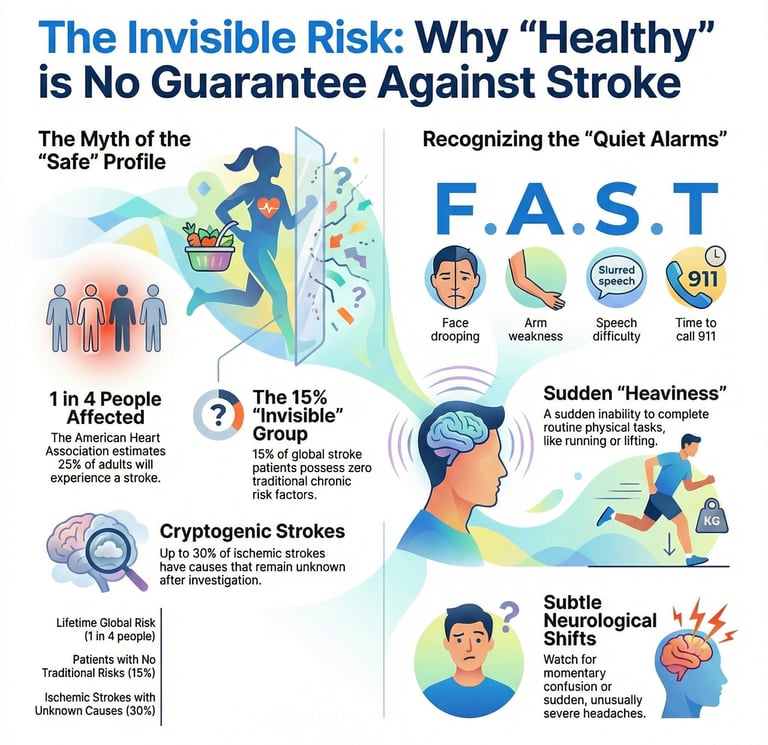
Statistic 1: The Invisible Risk. According to a 2023 report from the World Stroke Organization, approximately 15% of all stroke patients globally do not have any of the traditional, chronic risk factors like high blood pressure, diabetes, or smoking history.
The doctors kept repeating the same thing: "You are a very lucky man." I didn't suffer severe paralysis, which is common with haemorrhage strokes. But the question remained: Why?
The Hidden Factors That Can Lead to Stroke
The medical professionals offered a humbling perspective. While general profiles exist, they also see 80-year-olds smokers who abuse their bodies and never suffer a stroke, and fit 30-year-olds who do.
Why did my stroke happen? Beyond the simple blood pressure control, doctors look for deeper, often genetic, factors. While they may not share it publicly, they often advise patients like me to explore factors like:
Undiagnosed Vascular Issues: Small congenital weaknesses in blood vessels (aneurysms or AVMs) that may never cause trouble until a moment of minor stress.
Stress and Inflammation: Chronic, unmanaged stress can spike blood pressure irregularly, even if it measures normal during a routine check-up.
Cryptogenic Stroke: Up to 30% of ischemic strokes (a different type, but relevant) are classified as cryptogenic, meaning the cause remains unknown even after extensive investigation, as reported by the National Stroke Association.
The bottom line is that modern life and genetics mean anyone can be a candidate.
The Takeaway: Listen to the Quiet Alarms
My "heavy feeling" was an unusual sign. If I had remembered the simple F.A.S.T. acronym, I would have been better equipped.
Face drooping
Arm weakness
Speech difficulty
Time to call emergency services
But what about the subtle signs?
Unexplained Fatigue: A sudden inability to complete a routine physical task (like my run).
Momentary Confusion: A brief inability to process simple information.
Sudden Headache: Especially severe or unusual.
If something feels fundamentally wrong with your body—even if you're "healthy"—you must treat it with urgency. As I navigate recovery, I've had to radically rethink what "healthy" truly means.
Statistic 3: The Lifetime Risk. The American Heart Association estimates that about 1 in 4 people worldwide will be affected by a stroke in their lifetime. Don't assume you're the one in four who won't be affected.
What’s Next?
My recovery journey is just beginning, involving diet changes, new exercise regimes, and grappling with the complexities of insurance claims.
Follow along for my next update, where I reveal the specific, often genetic, factors the doctors suggested I look into and how my diet has changed. My immediate lifestyle and diet changes after a stroke
Find out how I had a second stroke and survived again!
Frustration with challenges for insurance and medical bills.
Leave a comment below sharing your own story or the most unexpected thing you learned about stroke risk!
Disclaimer: I am sharing my personal journey as a stroke survivor and does not constitute professional medical advice. Always consult with a qualified healthcare provider for any health concerns or before making changes to your health regimen.

Address
Blk 8 Cantonment Close
SIngapore